Draft Wildfire and
Landscape Resilience
Action Plan
2026-2031
Partner Review Period Through August 7, 2026

The California Wildfire and Landscape Resilience Action Plan (2026 – 2031) aligns activities and investments across Task Force partners to take coordinated action to confront wildfire challenges while equipping regional and local agencies with the tools to rapidly scale and sustain their efforts. Science, data, and shared technology sit at the center of the Plan, connecting three linked efforts: 1) landscape resilience; 2) community wildfire preparedness, and 3) a framework for mobilizing regional action.
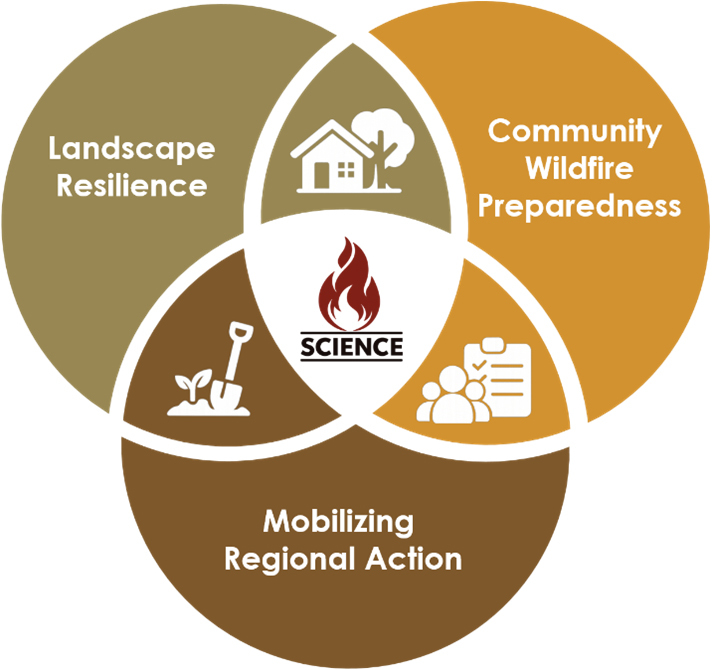
Together, these elements reinforce one another: landscape treatments reduce fire severity and spread near communities; community preparedness protects people and reduces losses; and coordinated regional delivery enables effective actions that build wildfire resilience.
- The Landscape Resilience Section introduces a bold new 10-year strategy focused on the state’s highest-risk landscapes. Prioritizing treatment of these high-risk or overly dense landscapes maximizes wildfire risk reduction and ecological benefits and sets the stage for rapidly scaling beneficial fire and ignition reduction programs to maintain the resilience of the state’s fire-adapted landscapes.
- The Community Wildfire Preparedness Section applies a holistic, multi-domain approach to reducing wildfire impacts in and around communities, combining actions in the built environment with the community programs and systems that enable sustained planning, preparedness, and recovery. It focuses on scaling the mitigations that matter, strengthening tribal and local capacity and coordination, and improving the data and tools needed to target investments and track outcomes.
- The Mobilizing Regional Action Section will guide local and regional collaboratives to address unique risks and needs across California. This Plan supports a network of partnerships to develop Regional Priority Plans that cover all federal, state, tribal, and local wildfire community and landscape resilience projects within each region. The Action Plan Regional Overviews outline the current conditions, primary threats, and key resilience strategies for Northern California, the Sierra Nevada, the Central Coast, and Southern California.
Share Your Input on the Plan
The Task Force encourages members of the public, tribes, local governments, community organizations, and partners across California to review the draft Plan and provide feedback during the partner review period, which closes August 7, 2026.
Development of the Plan
How Science Informs the Action Plan: The Action Plan draws on a broad body of scientific research on the key risks facing California’s landscapes and communities, as well as the effectiveness of resilience strategies and programs. The Task Force commissioned its Science Advisory Panel to prepare a synthesis of recent wildfire resilience research and a comprehensive set of findings (Science Synthesis) to inform the Plan’s priorities and strategies. CAL FIRE’s forthcoming 2025 Forests and Rangelands Assessment and the California Air Resources Board’s (CARB) 2025 Natural and Working Lands Carbon Inventory also provide essential information on the health of the state’s forests, shrublands, and grasslands, and the diverse wildfire risks facing California.
How Tribal Input and Traditional Ecological Knowledge Inform the Action Plan: The Action Plan was developed in collaboration with California Native American tribes and tribal organizations to ensure the plan is grounded in a foundation of Traditional Ecological Knowledge (TEK) and tribal science. The Action Plan was informed by input gathered during a 60-day tribal consultation period which included two tribal roundtable sessions. Additionally, the Action Plan pulls from California’s Strategic Plan for Expanding Beneficial Fire, which underwent significant tribal input and review and has been developed in alignment with CNRA’s Tribal Stewardship Policy.
Building on Nation-Leading Progress:
The Action Plan builds on years of collective action that have helped protect and promote resilience for communities and landscapes across California. With the 2021 Action Plan serving as a roadmap, California has increased spending on wildfire resilience to make a real impact on-the-ground protecting communities and landscapes across the state. Since 2021, Task Force partners have:
- Surged wildfire resilience investments to more than $6 billion;
- Doubled down on community protection, leading the nation with over 1,500 local Firewise USA® communities;
- Funded more than 2,000 wildfire resilience projects;
- Increased wildfire resilience treatments to over 700,000 acres annually;
- Nearly doubled prescribed fire statewide with roughly 200,000 acres treated annually; Improved data sharing and public transparency through a first-of-its-kind Interagency Treatment Dashboard, that displays completed vegetation management projects across the state; and
- Supported Indigenous stewardship and cultural fire through the Governor signed SB 310.
Background on the Task Force
The California Wildfire & Forest Resilience Task Force was created by the office of Governor Gavin Newsom to directly confront the near perfect storm of climatic and human-caused conditions that have brought the threat of devastating wildfire and its far-reaching effects to the doorstep of nearly everyone in our state, and beyond.
The Task Force is a collaborative effort to align the activities of federal, state, local, public, private and tribal organizations to support programs and projects tailored to the unique priorities and risks of each region. It brings the best available science to landscape management and community protection efforts, along with invaluable tools and resources for tracking progress and documenting effectiveness.
It’s a comprehensive and coordinated effort that continues to deliver significant progress in protecting people and property while improving the health and resilience of the natural lands we love and rely on.
Addressing the Unique Needs of California’s Diverse Regions
Recognizing that wildfire resilience must be tailored to local conditions, the Action Plan is supplemented by Regional Overviews that outline the current conditions, primary threats, and key resilience strategies for Northern California, the Sierra Nevada, the Central Coast, and Southern California.