
The Foundation
of the Action Plan
Introduction
California stands at a pivotal juncture in addressing our state’s ongoing wildfire crisis. Under Governor Gavin Newsom’s leadership, no state has organized and invested more to protect our communities and landscapes from catastrophic wildfire, with visible and measurable results. Yet as climate conditions have worsened, no state has suffered more from the devastating impacts of catastrophic wildfires and mass tree mortality events.
In the years since the California Wildfire and Forest Resilience Task Force (Task Force) released the state’s first comprehensive Wildfire and Forest Resilience Action Plan in 2021, state government and its tribal, public, and private partners have collectively invested billions of dollars in wildfire resilience projects, streamlined project approvals, and coordinated federal, state, local, private, tribal programs. Since 2021, Task Force partners have surged proactive wildfire resilience investments to more than $6 billion, funding more than 2,200 wildfire resilience projects across the state that have made a measurable difference protecting communities and landscapes. A summary of these completed actions is available in California’s Wildfire Resilience Accomplishments.
Despite this historic progress, California’s wildfires are continuing to burn hotter, larger, and more destructively. Fifteen of the most destructive wildfires in California state history have occurred since 2015, with devastating consequences for lives, property, and public health. California has suffered most of the recent structure loss to wildfire in the United States, including the devastating January 2025 Los Angeles fires, which tragically claimed 31 lives and destroyed more than 16,000 structures.
Building the Foundation for a Resilient Future
The focus of the 2021 Action Plan was to align federal, state, local, tribal, and private efforts to confront the state’s wildfire crisis. For the first time, all key state and federal wildfire resilience programs were identified in one place, together with nearly one hundred specific actions to collectively move them forward. These actions formed a roadmap that guided unprecedented levels of investments and actions by key agencies and their tribal, public, and private partners.
Now, our challenge is to build on this alignment and progress to provide a clear, sustainable path to ensure long-term wildfire resilience for California’s communities and landscapes. This requires that we carefully focus our resources and employ new science-based strategies to most effectively and efficiently achieve the pace and scale of action that this crisis demands.
To meet this challenge, the 2026 Action Plan builds upon our collective progress since 2021, particularly in the following areas:
Scientific Consensus on Priority Actions: We have learned a great deal in the past few years about the wildfire risks facing our communities and landscapes as well as the most effective approaches to reduce these risks. These key findings are described in the 2026 report produced by the Science Advisory Panel to the Task Force, A Science-Based Synthesis to Safeguard People, Communities, and Ecosystems from Wildfire in California (Science Synthesis).
Across our diverse forests, it is clear that significantly increasing ecologically based thinning, beneficial fire, and active reforestation, together with strategically planned and regularly maintained fuel breaks, is the most effective approach to improve wildfire and forest resilience.
Within our communities, home hardening and defensible space are vital to protect homes and businesses, and wildfire preparation is far more effective when an entire neighborhood or community participates. And most important, just as California’s landscapes have evolved, adapted, and thrived with fire, we must design and retrofit our homes, neighborhoods, and communities to safely and sustainably coexist with periodic fire.
We have also learned through our Task Force regional meetings that each area of our state faces unique risks. In much of the Sierra Nevada and Northern California, our forests are often too dense and lack the regular intervals of low-and-mixed severity fire that are vital to strengthen resilience and preserve biodiversity. In much of Southern California, by contrast, fire has been too frequent, sparked by unwanted, human-caused ignitions during high wind events that have resulted in large and destructive fires. These differences require regionally tailored strategies aligned with local risks, conditions, landscape type, fire regimes, and organizational capacity.
Building Capacity: We’ve also invested heavily in supporting tribal, local, and regional groups to better organize themselves, set priorities, plan, and execute wildfire resilience projects. Through the Department of Conservation’s (DOC) Regional Forest and Fire Capacity (RFFC) Program, the state has invested more than $150 million in 20 regional planning initiatives covering the most fire-prone regions of the state, resulting in durable partnerships and greater organizational capacity. As a result, many of these regional groups have grown in their capacities and can now accept larger grants to carry out multiple projects over many years, enabling expanded wildfire projects across the state. In addition, 51 of 58 counties have hired “County Coordinators” through the California Fire Safe Council to help increase local capacity.
On federal lands, Good Neighbor Agreements and related mechanisms with the U.S. Department of Agriculture (USDA) Forest Service and the Bureau of Land Management (BLM) have the potential to accelerate cross boundary work and projects on federal land.
Fast-Tracking Approvals: Governor Newsom has made streamlining regulations one of the hallmarks of his administration while maintaining California’s nation-leading environmental protections. Shortly after taking office in 2019, the Governor issued an Emergency Proclamation to suspend the California Environmental Quality Act (CEQA) to complete 35 high-priority fuel reduction projects to protect the state’s most vulnerable communities. In the same year, the California Board of Forestry and Fire Protection streamlined environmental review and permitting for forest health and wildfire prevention projects within non-federal timberlands and in 2020, established the California Vegetation Treatment Program (CalVTP), providing CEQA coverage for non-commercial forest health and wildfire resilience projects. In 2022, the Governor signed Assembly Bill (AB) 211 (Committee on Budget, 2022) which extended to January 1, 2028 the sunset date of the CEQA exemption created by Senate Bill (SB) SB 901(Dodd, 2018), which allows State-funded fuel treatment projects on federal lands to bypass CEQA if a National Environmental Policy Act (NEPA) review has already been conducted.
The Governor also issued an Emergency Proclamation directing the California Natural Resources Agency (CNRA) and the California Environmental Protection Agency (CalEPA) to expedite critical fuels reduction projects while protecting public health and the environment. Through this streamlined process, California fast-tracked approval of over 540 critical landscape health and wildfire resilience projects, exceeding 140,000 footprint acres, to better protect communities, infrastructure, and natural landscapes across the state. SB 1370 (Stern, 2026) establishes a durable framework to extend this expedited review process.
Investing in Cutting-Edge Science and Data Tools: The Task Force and its partners have built cutting-edge science and data tools to help local and regional groups better plan, prioritize, and evaluate the benefits of their projects. The Task Force launched an Interagency Treatment Dashboard to track wildfire resilience projects statewide, and California Department of Forestry and Fire Protection (CAL FIRE) released its Fuels Treatment Effectiveness Dashboard to better measure the effectiveness of these efforts in reducing the impacts of uncontrolled fires. The Task Force also developed the California Landscape Metrics, and CNRA launched Planscape, a decision support platform co-developed with the USDA Forest Service and Google.org, to help local and regional entities better evaluate the health and resilience of their landscapes and prioritize projects.
Together, these collective efforts lay the foundation to not only sustain our progress, but to shift to a new set of focused and cost-effective strategies that improve the resilience of our communities and landscapes. They are also part of a broader set of changes that are transforming how the state manages its wildfire resilience programs to match the scale of effort required to address this crisis.
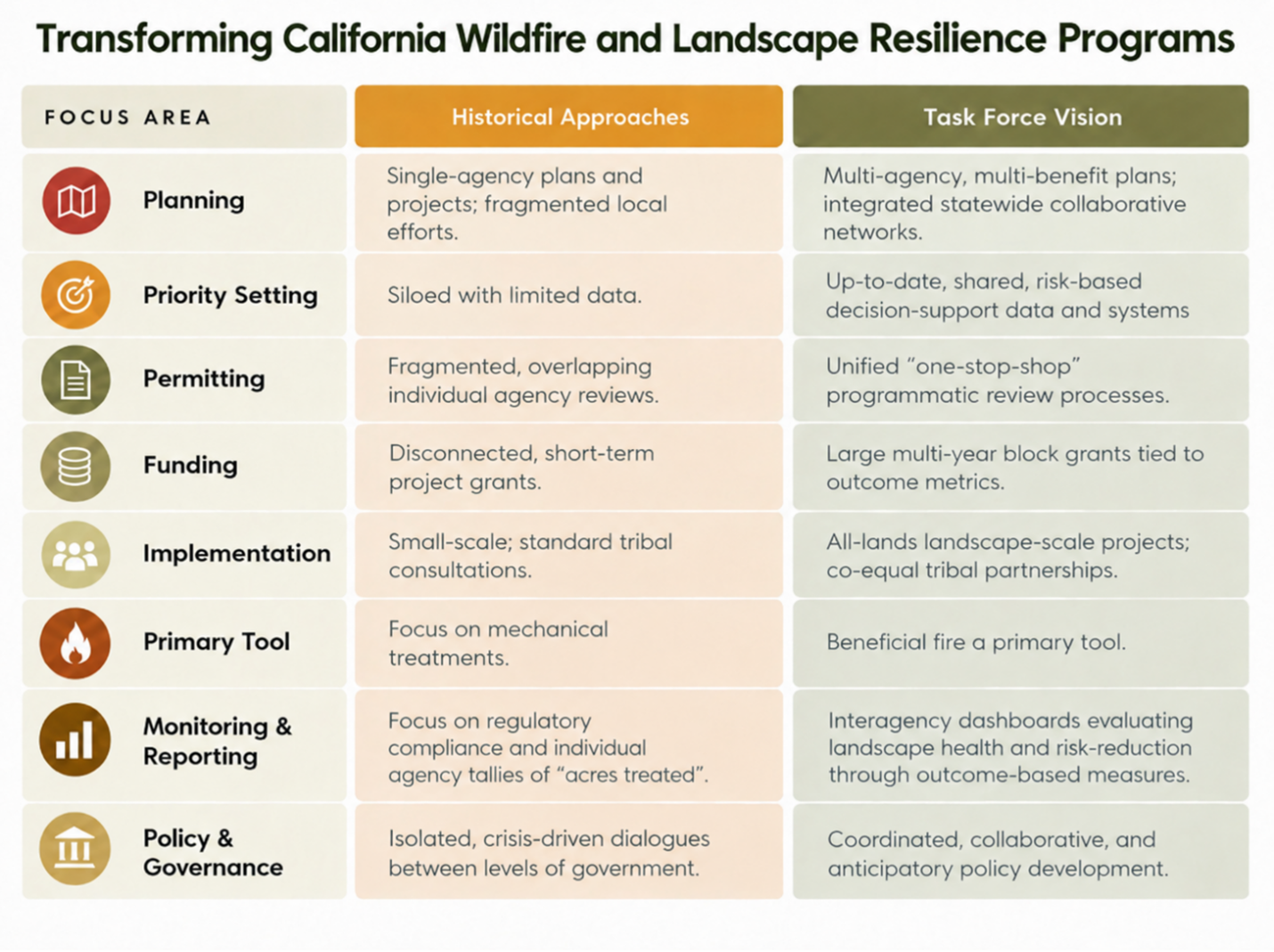
As described below and in more detail in Section 3, the Task Force and its partner agencies are reevaluating and rethinking every aspect of their programs to help local and regional collaboratives more effectively address their key priorities. While federal, state, and local agencies have long recognized the importance of partnerships and scaling up their work, until recent years, they have often lacked the capacity and legal and policy framework to work across agency boundaries or jointly plan, prioritize, and fund projects. As a result, collaborative efforts have thrived in some regions and pilot areas but not others. To bridge these gaps, the Task Force’s 2021 Action Plan accelerated a shift away from the historically more fragmented approaches depicted in the following table. In its place, the Action Plan established a new science-driven framework for collaborative plans and projects across the state. The right-hand column depicts our collective vision for this updated Action Plan and beyond.
Task Force and Action Plan Background
The California Wildfire and Forest Resilience Task Force was originally established in 2018 through Executive Order B-52-18 to coordinate state, federal, tribal, local, and regional partners in addressing the state’s escalating wildfire crisis. In January 2021, the Task Force released California’s first Wildfire and Forest Resilience Action Plan and launched an ongoing series of regional meetings to hear directly from local and regional leaders about their key issues and opportunities.
To oversee the Plan, Governor Newsom restructured the Task Force in April 2021. He established an Executive Committee co-chaired by CNRA and the USDA Forest Service, and expanded its membership to include federal, state, and county representatives, together with the Indigenous Stewardship Network. The Task Force is also supported by a Science Advisory Panel and about a dozen interagency and stakeholder-driven work groups and partners. These groups and partners help shape, inform, and align a broad range of interagency programs, including the many cross-cutting initiatives described in Section 4.
To highlight the value of this collective effort and their invaluable contributions, Task Force key agency and nongovernmental partners are both cited throughout the Action Plan. The Task Force is cited as a lead when its small interagency team is playing a convening role.
The responsibilities of the Task Force were formally codified under SB 456 (Laird, 2021), which directs the Task Force to develop a comprehensive implementation strategy for its Action Plan, update the plan every five years until 2048, and submit annual progress and expenditure reports to the Legislature. In summary, by seeking to align policies, funding, and regional efforts, the Task Force and its Action Plan serves as a statewide forum and framework dedicated to reducing wildfire risks, protecting communities, and restoring the long-term ecological health and resilience of California’s forests and wildlands.