

Landscape
Resilience Strategy
The Landscape Resilience Strategy (Strategy) draws on the latest scientific findings, data, and tools to provide a clear, sustainable path toward wildfire and landscape resilience across California’s fire-adapted landscapes, including forests, woodlands, grasslands, and shrublands. The Strategy also fulfills the Task Force mandate, as described in SB 456 (Laird, 2021) to identify treatment priorities and establish annual goals.
The Strategy works in tandem with the other three pillars of this Action Plan – the Community Wildfire Preparedness Strategy, the Mobilizing Regional Action Strategy, and Cross-cutting Initiatives – to accelerate progress where it matters most. It establishes clear priorities for where and how to treat California’s fire-prone landscapes, aiming to minimize catastrophic fire risk while securing broader environmental benefits.
As a high-level statewide framework, the Strategy is designed to be refined and adapted by regional collaboratives to address the unique localized conditions of California’s diverse landscapes and communities.
The Strategy has three primary goals:
- Reduce wildfire hazards to communities and landscapes
- Restore health to forests, shrublands, and grasslands
- Promote long-term beneficial fire in forests and appropriate fire frequencies in shrublands
How Science Informs the Landscape Resilience Strategy
The Landscape Resilience Strategy is grounded in extensive scientific research, core ecological principles, and advanced spatial data. Specifically, it synthesizes key findings from three foundational sources:
MORE
- A synthesis of recent wildfire resilience research prepared by the Science Advisory Panel.
- A 2025 collaborative modeling study by the California Department of Forestry and Fire Protection (CAL FIRE), American Forests, and the U.S. Department of Agriculture (USDA) Forest Service—hereafter referred to as the 2025 American Forests Report
- A comprehensive statewide modeling effort directed by the Task Force and conducted by the Spatial Informatics Group – hereafter referred to as scenario modeling
The 2025 American Forests Report provides a strong foundation for the Landscape Resilience Strategy. It identified nearly 11 million forested acres in California at high or very high risk for wildfires and proposed a 10 year surge in resilience treatments across these areas. [1] Promptly treating these lands restores forest health and helps ensure future wildfires burn at low and mixed severity. This approach also reduces long-term carbon losses and tree mortality while easing the demand for costly post-fire reforestation in areas that cannot naturally regenerate. Additionally, these treatments make it safer to reintroduce beneficial fire to fire-adapted ecosystems.
In coordination with its Science Advisory Panel, the Task Force interagency team supplemented the American Forest Report by modeling various management scenarios in both forests and shrublands to assess the most effective approaches to improving landscape resilience (Appendix XX).
Key findings from the scenario modeling include:
- Target High-Hazard Forests: Treating the highest hazard forests first yields nearly 4x greater reduction in high-severity fires than treating more acres with lower hazard.
- Scale Up Forest Treatments: Expanding forest treatments drives broader improvements in forest health and more effectively alters wildfire behavior.
- Target the Wildland-Urban Interface (WUI): Prioritizing the highest-hazard WUI areas delivers nearly 3x greater reduction in burn probability than treating more acres with lower hazard.
- Focus on Forest Health: Looking beyond fire hazard reduction to improving general forest health boosts long term forest resilience against drought, disease, and insects as the climate warms. Millions of acres of forests across California are at low risk of wildfire but at high risk for tree mortality from drought and rising temperatures.
- Treat Additional Acres for Multi-Benefit Returns: While the direct wildfire risk-reduction benefits taper off as treatments expand into lower-hazard areas, in many areas treating these acres improves the health and resilience of the ecosystems that our economic and social systems depend upon and secures vital improvements in air quality, water security, recreation, and carbon storage.
These insights reinforce a long-standing body of science that reflects similar findings and directly shaped the core concepts and treatment levels called for in the Landscape Resilience Strategy. But because the Strategy does not dictate specific prescriptions for individual areas, tribal, local, and regional leaders must carefully analyze landscape conditions to translate these overarching principles into locally effective treatments.
Finally, both the Landscape Resilience Strategy and the Community Preparedness Strategy recognize that wildfire resilience requires ongoing stewardship. Ongoing maintenance treatments are essential to sustain the value of today’s investments.
Core Concepts
The Strategy is organized around three core concepts:
MORE
- Treat the Worst First: The Strategy prioritizes landscape treatments in California’s highest-wildfire hazard areas, including, frequent ignition areas, and dense, unhealthy forests vulnerable to drought-induced die-offs. It also prioritizes protecting vulnerable communities and critical assets like essential infrastructure and ecologically significant landscapes. Specific treatments will vary by region and ecosystem type.
- Set the Stage for Beneficial Fire: Restoring fire at appropriate intensities and intervals is essential to sustaining California’s fire-adapted landscapes. The Strategy encourages land managers to reduce fuel densities, establish strategic fuel breaks and Potential Operational Delineations (PODs), and expand capacity to safely scale up the use of beneficial fire. Together, these treatments can also create safer conditions for the use of managed wildfire, allowing unintentional ignitions to be used as a tool to reduce fuels and restore fire-adapted ecosystems when conditions are appropriate. Managed wildfire has potential to be a cost-effective and efficient tool for reintroducing fire and achieving broad-scale landscape management goals.
- Restore Post-Fire Landscapes: High-severity fires can inhibit natural regeneration, putting millions of forest acres at risk of permanently converting to shrublands or grasslands. The 2025 American Forests Report warns that California could lose nearly half of its forests by 2071 without scaled-up forest health and reforestation efforts. Additionally, too-frequent fires put vast areas of native shrublands—particularly in Southern California—at risk of converting to invasive grasslands, requiring active restoration.
Landscape Resilience Treatment Levels
MORE
The Landscape Resilience Strategy adopts a phased approach. Over the next ten years, wildfire and land management agencies should focus on treating high-hazard landscapes, expanding prescribed and cultural fire, and reducing the restoration backlog. By prioritizing these high-hazard areas first, the Strategy establishes the necessary groundwork for a long-term transition toward protecting and sustaining landscape health primarily through maintenance thinning and beneficial fire.
As overall landscape conditions improve and community fire preparedness increases, land managers will gain more opportunities to deploy beneficial fire, including by strategically utilizing natural ignitions to treat additional acres, the most cost-effective method for maintaining and enhancing long-term ecological health. The long-term goal of this approach is to ensure that a much greater portion of future wildfire acres are occurring at low and moderate severity.
The Strategy calls on federal, state, local, private, and tribal partners to prioritize treatment of 850,000 to 1.25 million acres of the state’s highest risk landscapes annually over the next ten years. As shown below in Figure 1, meeting this goal requires California to maintain the steady expansion of vegetation treatments achieved since the 2021 Action Plan.
These priority treatment levels align directly with the one-million-acre target set by the 2021 Action Plan and the landmark 2020 Shared Stewardship Agreement between the State of California and the USDA Forest Service. They also contribute significantly to the state’s Nature-Based Solutions Climate Targets. As noted previously, expanding treatments beyond the priority-based levels in the Strategy can provide multiple benefits, including enhanced water security, recreation, and carbon storage, along with reduced wildfire smoke exposure and related health impacts.
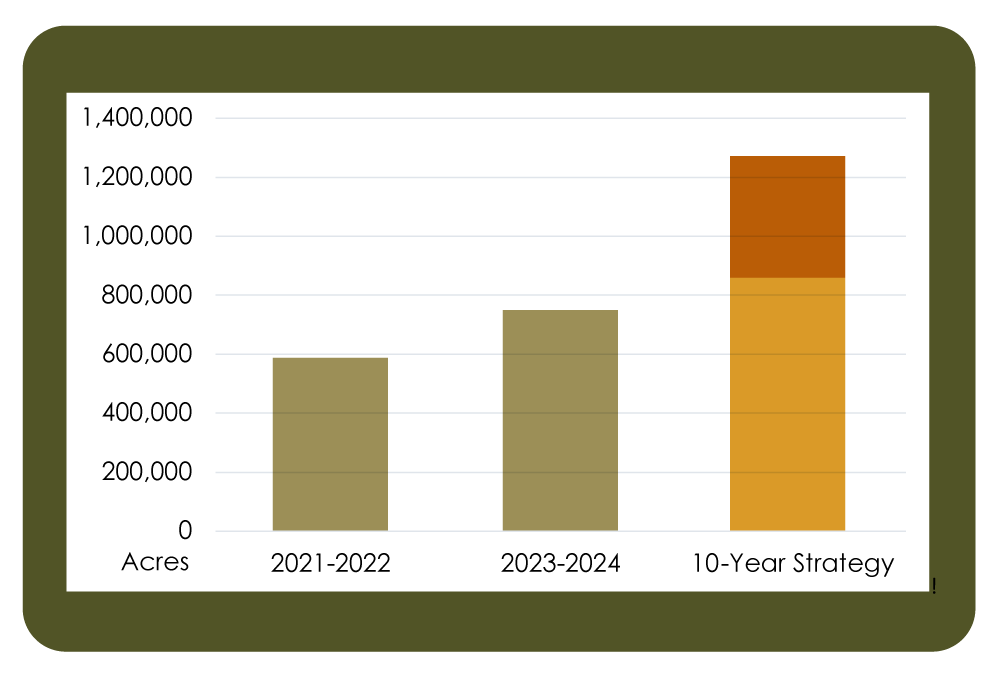
Figure 1. Average annual footprint acres treated from 2021-2024. The top portion of the rightmost bar displays the lower and upper range (850,000 to 1.25 million acres) of priority annual treatment identified as needed under the Ten Year Strategy.
Achieving Landscape Resilience through Collective Action
MORE
In addition to scaling up treatments, the state must increase and align investments in other key areas of wildfire and landscape resilience, including ignition prevention during extreme wind events, utility corridor and roadway hardening, and the replacement of highly flammable “flashy” fuels with more fire-resistant native vegetation.
The Landscape Resilience Strategy also requires coordinated action at local, regional, and statewide scales. As described in the Mobilizing Regional Action section, Regional Priority Plans, supported by increasingly sophisticated decision-support tools, will identify regionally specific landscape resilience risks and priorities, facilitate local actions, and drive the progress of statewide policy goals.
Beyond regional coordination, successfully scaling landscape treatments depends upon a suite of statewide priorities, as described in the Cross-cutting Initiatives section. These include expanding tribal stewardship, developing a wildfire resilience workforce, streamlining environmental permitting, and growing wood utilization capacity. Together, these integrated efforts will help dismantle implementation barriers, strengthen capacity, and accelerate coordinated action across ecosystems and land ownerships.
MEASURING OUTCOMES THAT MATTER
Measuring progress is vital for maintaining accountability to Californians and adapting strategies over time. To build upon and expand from reporting acres treated, the Task Force partners are committed to developing outcome-based measures of performance.
MORE
Measuring acres treated provides critical information about level of effort and contributes to our understanding of carbon dynamics, but it doesn’t answer important questions, such as: How much has wildfire risk been reduced? Has the health of our forests and rangelands improved? Has the resilience of key ecosystem services increased? What is the true return on these public and private investments?
Outcome-based measures directly answer these questions by tracking the measurable effects of treatments on wildfire risk and landscape condition. Because the same measures can be calculated from projected conditions before treatments to set priorities and from measured conditions to assess results, they provide a unified framework for both planning and reporting, even in years or places that are not tested by wildfire. Accordingly, as described in the Mobilizing Regional Action section, the USDA Forest Service, the Department of Conservation (DOC), and other Task Force partners will work with regional collaboratives to use outcome-based measures to model both the results of past projects captured in the Interagency Treatment Dashboard and the potential benefits of planned projects developed through Regional Priority Plans and interagency 5-year plans of work.
This approach builds on the Core Reporting Metrics effort that the Task Force launched in 2024 through a public workshop and survey process, and it draws on parallel advances by the USDA Forest Service. Forest Service Research and Development has led a multi-year, cross-agency collaboration to develop Outcome-Based Change Metrics that apply sophisticated fire, landscape, and economic modeling to generate quantitative and replicable metrics across its 21 highest-risk landscapes.
Both initiatives recognize three essential features of a robust reporting system:
- Action Responsive: Metrics must directly respond to management actions.
- Measurable and Replicable: Metrics must be practical to remeasure after treatment, ensuring that realized benefits are quantifiable.
- Transparent Methodology: Metrics must rely upon consistent, transparent methods.
Example: Using Flame Length as an Outcome Metric
Reducing wildfire intensity is a shared goal of state and federal land managers. One useful measure of progress is how treatments change expected flame lengths if a wildfire burns through a treated area. Flame length is closely tied to fire intensity and has clear practical meaning. It affects how difficult a fire is to suppress and how much risk it poses to important resources. It also responds to changes in fuels, so it can show the effects of thinning, prescribed fire, and other treatments.
Because flame length can be estimated before and after treatment using the same assumptions, it provides a consistent way to measure treatment benefits. Furthermore, since the underlying USDA Forest Service methodologies are publicly available, the results can be independently verified, helping to build strong public confidence and scientific validity into the assessments.
Wildfire hazard reduction is just one of the priorities driving the Landscape Resilience Strategy. Other goals include improving forest and shrubland resilience, protecting critical ecosystems, conserving biodiversity, limiting smoke exposure, enhancing watershed integrity, and maintaining recreational opportunities. A range of metrics can track progress toward these diverse objectives.
At the same time, science is advancing rapidly, with new methods and metrics continuing to emerge. Thus, a robust process is needed to establish a common set of core metrics while allowing new measures to be incorporated as science advances.
A Collaborative and Adaptive Framework
To meet this need, the Task Force has launched an iterative process that brings together Task Force leadership, key stakeholders, scientists, and an interagency team. These groups will work together through a process grounded in four principles, ensuring that the resulting measures are credible and widely adopted:
- Inclusive: A Stakeholder Advisory Group, composed of the agencies, organizations, and communities that apply the metrics, will help Task Force partner agencies develop measures that are practical and relevant.
- Science-based: The Science Advisory Panel will provide rigorous technical reviews of candidate metrics and share their assessments.
- Practical: An interagency team will advise on the practicality and durability of ongoing measurement of the outcomes.
- Adaptive: Because the process repeats annually, core metrics can be continually refined, new measures added, and priorities updated over time.
BENEFITS OF THE LANDSCAPE RESILIENCE STRATEGY
The Task Force led a public-private team that used results from the scenario modeling and peer-reviewed literature to quantify the benefits of implementing the Landscape Resilience Strategy (Appendix XX). As described in How Science Informs the Landscape Resilience Strategy, the modeling results demonstrated how implementing the first 10 years of prioritized treatments called for in the Strategy would affect burn probability, burn severity, and tree density. These changes, in turn, would have significant implications for a broad range of ecological and other benefits. Several of these benefits, established in the peer-reviewed literature, are described below:
MORE
Improving Air Quality and Public Health: Fine particulate pollution (PM2.5) from wildfire smoke poses an immediate public health crisis, causing thousands of annual premature deaths and severely harming economic productivity (Science Synthesis). Expanding prescribed burning serves as a core pillar of the Strategy to significantly reduce net toxic air pollutants and secure tens of billions of dollars in societal savings [2] [3] [4] [5] .
Protecting Communities and Critical Infrastructure: Severe wildfires have inflicted billions of dollars in structural damage across California and destabilized statewide insurance markets. Regional modeling demonstrates that executing forest thinning and beneficial fire treatments reduces structural loss risks by up to 76 percent for thousands of homes [6] ,but must be paired with home hardening, defensible space and other parcel and community-based practices to fully support community resilience.
Protecting Biodiversity: Catastrophic high-severity wildfires threaten California’s unique biodiversity, damaging critical terrestrial habitats for vulnerable species like giant sequoias [7] and the California spotted owl [8] and the aquatic resources that salmonids and other aquatic species rely on. The Strategy promotes ecological thinning and beneficial fire to safeguard old-growth forests and ignition-reduction projects to allow degraded shrubland habitats time to recover.
Preserving Recreation Assets: Climate disturbances and intense wildfires inflict severe economic damage on California’s outdoor recreation sector, through impacts such as millions of dollars in lost winter recreation value and canceled camping reservations [9] [10] . Prioritizing targeted thinning and beneficial fire minimizes these disruptive, large-scale public land closures while protecting critical infrastructure like roads, campgrounds, and ski areas.
Safeguarding Watersheds, Water Supplies, and Hydropower: High-severity wildfires trigger catastrophic post-fire soil erosion that impairs water quality, destroys fisheries, and clogs reservoirs with sediment. By mitigating destructive fire behavior, the Strategy preserves the snowpack-regulating forest canopy and can generate up to $2,000 per acre in avoided-erosion benefits in high wildfire hazard, highly erodible watersheds with downstream reservoirs (Appendix XX).
Reducing Carbon Loss: Active landscape treatments significantly reduce carbon losses from extreme wildfires and protect the long-lived carbon stored within mature ecosystems[11] [12] [13]. The Task Force scenario modeling, other agency modeling efforts, and academic literature shows that proactive forest management can reduce carbon losses from severe wildfire, protect long-lived carbon stored in mature trees, and avoid millions of tons of greenhouse gas emissions [14]. While climate change may make some forest carbon losses inevitable, active management can limit the extent of these losses relative to the state’s current trajectory.
Strengthening the Rural Economy: Decades of decline in California’s forest-based industries have severely strained rural economies, making it difficult to find viable markets for restoration biomass. Scaling strategic forest health treatments will help revitalize these regions by creating skilled local jobs and transforming excess wood into valuable bioenergy and forest products.
Summary: Interconnected Benefits of Landscape Resilience: Strategic investments in landscape resilience provide multiple benefits and deliver billions of dollars in annual returns that significantly exceed initial treatment costs across California’s landscapes and can ultimately reduce expenses on fire suppression and post-disaster recovery [14].