

Community Wildfire Preparedness Strategy
California communities face escalating wildfire risks driven by climate change, expanding development, and extreme fire behavior. California Department of Forestry and Fire Protection (CAL FIRE)’s Fire and Resource Assessment Program 2025 Assessment reports that wildfires destroyed nearly 90,000 structures from 1990 through 2025, about three-quarters of them after 2015. In 2020, nearly 2.8 million homes were in designated Fire Hazard Severity Zones, and one in five homes statewide was in the wildland-urban interface (WUI).
The California Wildfire and Forest Resilience Task Force (Task Force)’s Science Advisory Panel found in its Science Synthesis that direct wildfire exposure in California is growing faster than in any other continental state. WUI expansion continues to put more homes in danger, and the devastating 2025 Los Angeles fires proved that extreme wildfires also threaten dense urban areas—destroying over 16,000 structures, claiming 31 lives, and projecting $10 billion in projected economic losses through 2029.
The impacts of these fires extend far beyond the burn zones. Wildfire smoke causes thousands of premature deaths annually, with 86% of hazardous smoke days since 2006 recorded after 2017. Indirect economic and social damages to healthcare, education, agriculture, and labor often exceed direct fire losses by tenfold. Between 2008 and 2018 alone, smoke exposure caused an estimated 52,500 to 55,700 premature deaths and $432–456 billion in economic impacts[16].
KEY ACTIONS TO PREPARE COMMUNITIES FOR WILDFIRE
How Science Informs the Community Wildfire Preparedness Strategy
A robust, growing body of evidence shows that home-, neighborhood-, and community-based actions are all vital to significantly increase wildfire resilience. Drawing on this data, the Task Force Science Advisory Panel’s Science Synthesis highlights the most critical actions:
- Plan and design for wildfire: Home location and community arrangement are the strongest predictors of structure loss. Future exposure must be minimized through fire-resistant community design and compact land use planning, while existing communities require targeted investments to retrofit legacy infrastructure.
- Build safer communities: Resilient infrastructure—including interconnected roads, reliable water supplies, backup power, and early warning networks—is essential to support safe evacuations and maintain critical functions during a fire. Evacuation plans must explicitly account for vulnerable populations and should be reinforced by temporary refuge areas or strategic fuel breaks where necessary.
- Harden homes and maintain defensible space: Installing ember-resistant vents, closed eaves, and multi-pane windows is vital because wind-blown embers are a primary cause of structure ignition. Managing defensible space complements these structural retrofits by eliminating continuous fuels, with improvements in the area closest to the home providing the highest level of protection.
- Prioritize community-wide action: The Science Synthesis and other research emphasize that wildfire resilience is most effective at the community level. Partnerships between residents, tribes, utilities, local governments, and emergency agencies are required to address systemic vulnerabilities that individual property owners cannot tackle alone.
- Engage residents and address barriers: Effective public engagement must build trust and provide targeted financial or technical resources to overcome socioeconomic and physical barriers to preparedness. Tailoring outreach to local values ensures sustained participation, with a necessary focus on communities facing the greatest hurdles to evacuation and recovery.
Finally, as with the Landscape Resilience Strategy, the Community Preparedness Strategy recognizes that wildfire resilience requires ongoing maintenance. Vegetation grows back, seasonal debris accumulates, and infrastructure fails. Maintenance activities are vital to ensure that the benefits of our investments today are sustained in the future.
A Transformational Legislative Package
Governor Newsom’s signing of a landmark legislative package on September 29, 2026, will transform the state’s efforts to improve community wildfire preparedness. The package includes pioneering new mandates for both structure and community home-hardening certification AB 1934 (Bennett, 2026) and AB 1964 (Bennett, 2026), a standardized validation framework to recognize community-wide progress AB 1960 (Bennett, 2026), and the California Wildfire Resilience Loan Program SB 894 (Allen, 2026) to provide low-interest financing for structural improvements. SB 973 (Becker, 2026) codifies the Wildfire County Coordinator Program, a program first established in 2021 with the goal of increasing local capacity to implement wildfire resilience activities and recover from wildfire incidents. By pairing these powerful legislative mandates with targeted state funding, California will fundamentally improve and reshape its approach to protecting homes and communities.
The legislation bolsters the state’s integrated framework for Community Wildfire Preparedness that connects three domains of action – the built environment, the surrounding landscape, and the community systems that organize people, institutions, and programs:
- The built environment includes buildings, structures and critical infrastructure that can be designed, retrofitted, or maintained to reduce vulnerability.
- The surrounding landscape includes forests, shrublands, and grasslands where wildfire can ignite and spread, including areas within and near the WUI.
- The community domain includes leaders and groups working together to plan, prioritize, coordinate, implement, and adaptively manage a comprehensive set of actions to build wildfire resilience. These actions include strengthening preparedness through improvements to the built environment and surrounding landscapes, protecting public health and safety, planning for evacuations, and recovery activities.
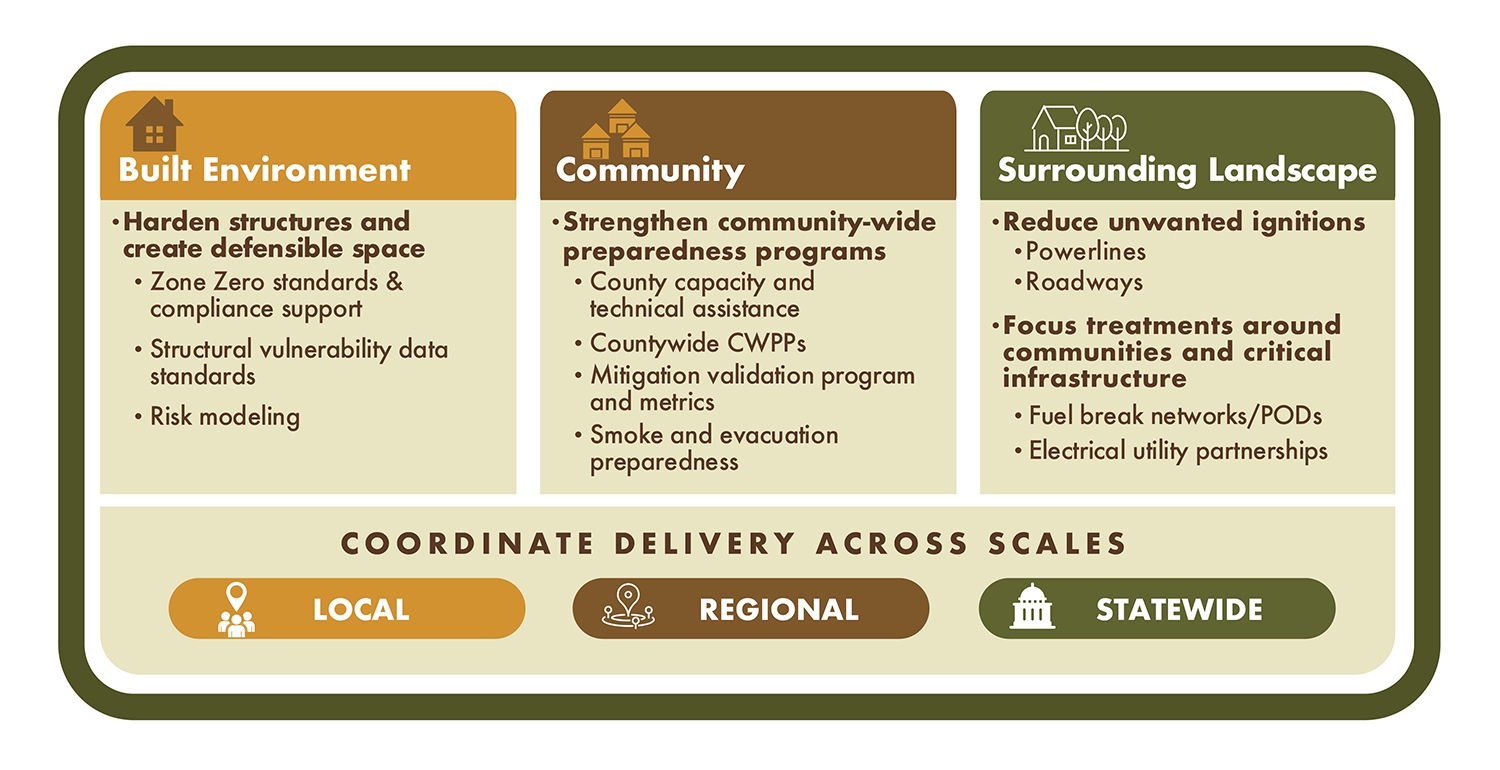
The Community Wildfire Preparedness Strategy is also based on coordinated delivery at statewide, regional, and local levels:
- CAL FIRE’s Office of the State Fire Marshal plays a central leadership role by establishing statewide standards and guidance for the built environment, developing and maintaining shared data and reporting systems, aligning program requirements, providing grants and technical assistance, and ensuring coordination across state, federal, tribal, and local partners.
- The California Board of Forestry and Fire Protection provides a governing role in community resilience, wildfire prevention, and protection by establishing and maintaining statewide policies, standards, and regulations that support wildfire preparedness and risk reduction.
- Regional and local organizations including counties, Fire Safe Councils, and wildfire prevention authorities establish wildfire resilience programs in their areas, which often include wildfire mitigations, evacuation planning, smoke preparedness, and land use planning.
- Local governments and community-based organizations implement and sustain work on the ground through neighborhood outreach and assistance, parcel- and community-scale risk reduction, and ongoing community readiness.
- Private landowners implement wildfire mitigation and preparedness measures on private lands, including vegetation management, defensible space, home hardening, and landscape-scale fuel reduction, contributing to broader community wildfire risk reduction.
- California Native American tribes lead, implement, and sustain community wildfire preparedness work on tribal lands. Tribal fire departments also provide critical mutual aid and emergency response services throughout California.