
Sustain Small Private
Landowner Stewardship
Non-industrial private forestlands cover approximately 8 million of California’s 32 million forested acres. Because these lands are often interspersed with public, tribal, and other private holdings, they are critical to an all-lands approach. California’s privately owned shrublands, oak woodlands, and rangelands are also essential to building resilient landscapes. However, small private landowners often face significant planning and implementation barriers, including limited technical knowledge, high treatment costs, complex regulations, and difficulty navigating assistance programs. Non-forest landowners also need guidance tailored to their unique landscape conditions and specific wildfire risks.
To deliver assistance more efficiently and at scale, state and federal agencies are increasingly shifting from individual landowner grants toward block grants for regional partners—such as Resource Conservation Districts (RCDs), Fire Safe Councils, and Prescribed Burn Associations. These partners can also integrate landowner assistance into larger-scale projects on adjacent public lands. Connecting private landowners with support through regional delivery networks benefits both landscape resilience and community wildfire preparedness.
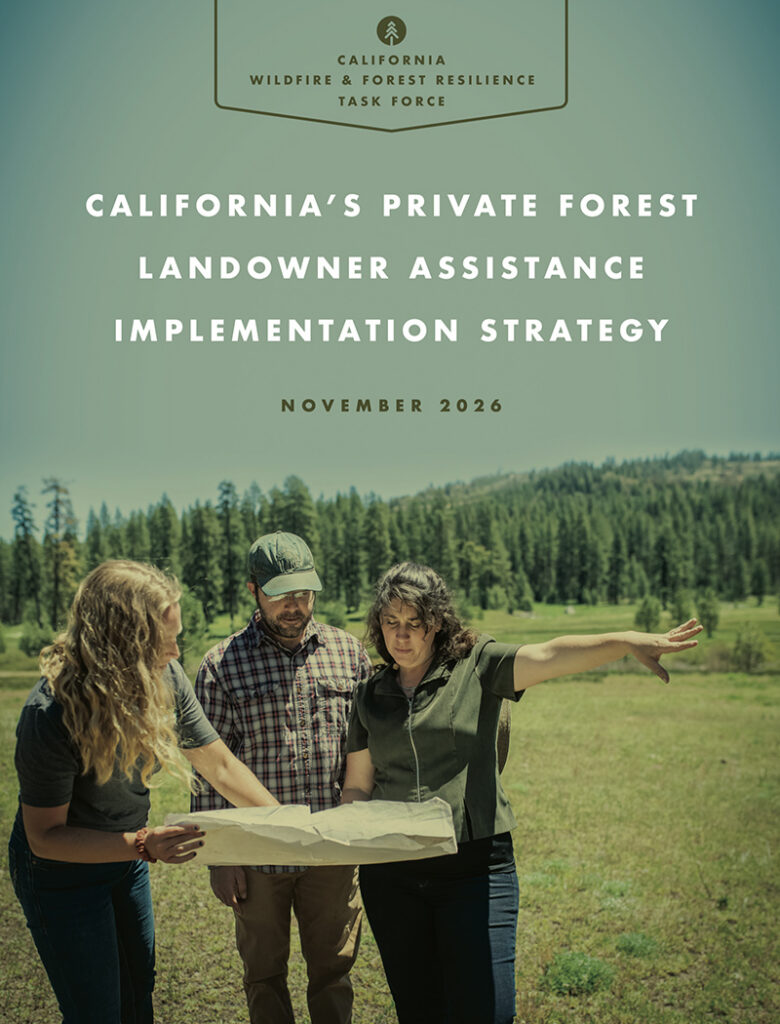
California’s Strategic Plan for Private Landowner Assistance
The Task Force published California’s Private Forest Landowner Assistance Implementation Strategy in 2026 to help small private landowners overcome barriers to forest management.
Key Actions
- 4.06 Sustain and Expand Landowner Assistance and Incentive Programs: State and federal agencies, along with RCDs and non-governmental partners will seek to sustain and expand technical, financial, and market-based assistance programs for private landowners. This includes expanding landowner education and technical assistance through RCDs and programs like University of California Agriculture and Natural Resources (UC ANR)’s Forest Stewardship Workshops. It also includes broadening participation in incentive and market-based programs including CAL FIRE’s California Forest Improvement Program (CFIP) and the Natural Resources Conservation Service’s (NRCS) Environmental Quality Incentives Program; exploring sustainability certification to promote California-grown wood products through the Timber Regulation and Forest Restoration Program and related partnerships; and developing tailored assistance pathways for underserved shrublands, oak woodlands, and rangelands.
- 4.07 Align Funding and Strengthen Regional Delivery: State and federal agencies will continue to coordinate their assistance programs—including CFIP, NRCS programs, USDA Forest Service assistance, Regional Forest and Fire Capacity (RFFC) Program, and Wildfire Resilience Block Grants—to better leverage available funding, reduce cost-share burdens and support regional priorities. Additionally, CAL FIRE, NRCS-CA, USDA Forest Service, and other partners will assist the Department of Conservation (DOC) with supporting the long-term capacity of regional partners and private non-industrial forest landowners.
- 4.08 Increase Outreach and Education to Small Private Landowners: CAL FIRE and the USDA Forest Service will continue to support, as funding allows, regular forest stewardship workshops for landowners through sustained funding to the UC ANR Forest Stewardship Education Initiative to continue offering forest stewardship and post-fire forest resilience workshops. Additionally, the California Association of RCDs Private Forestlands Committee, in coordination with the Task Force Communications Work Group, will seek to finalize an outreach plan focused on underserved landowners.
- 4.09 Provide Assistance for Rapid Post-Fire Restoration: As described in Action 1.19, CAL FIRE, the USDA Forest Service, and local agencies such as RCDs, will seek to expand EFRTs to rapidly assist private forest landowners impacted by wildfires.