
Promote & Expand
Sustainable Recreation
Wildfire and climate impacts are profoundly affecting California’s outdoor recreation system, disrupting access to public lands and water, and threatening the communities and economies that depend on them. In many rural and gateway communities, outdoor recreation is a significant economic driver, supporting local businesses, tourism, and jobs. When wildfires and other climate-driven disasters limit access to recreation areas, the resulting impacts ripple through local economies and affect community vitality. These interconnected impacts underscore the need to manage landscape health, wildfire resilience, and outdoor recreation as mutually dependent priorities.
In December 2022, the Task Force Sustainable Recreation/CALREC Vision Key Working Group developed the Joint Strategy for Sustainable Outdoor Recreation and Wildfire Resilience to provide a roadmap for advancing sustainable recreation access and strengthening the resilience of California’s recreation system, communities, and economies in the face of increasing wildfire and climate impacts.
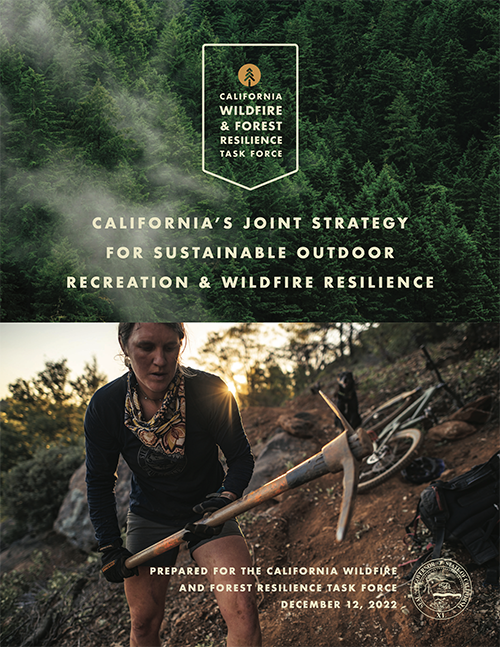
Explore California’s Joint Strategy for Sustainable Outdoor Recreation & Wildfire Resilience
The Task Force published California’s Joint Strategy for Sustainable Outdoor Recreation in 2022.
Key Actions
- 4.31 Implement California’s Joint Strategy for Sustainable Outdoor Recreation and Wildfire Resilience: The Sustainable Recreation/CALREC Vision Key Working Group will partner with CNRA, DOC, the USDA Forest Service, Bureau of Land Management (BLM), and state and local recreation managers, to deliver multi-benefit recreation and wildfire resilience projects in and near the wildland urban interface. Where appropriate, they will embed these priorities in RFFC Regional Priority Plans.
- 4.32 Leverage California Jobs First to Implement Multi-benefit Programs and Projects: Recreation and tourism industry sector coordinators from California Jobs First regions will develop best practices for job creation in the sector. This includes leveraging opportunities identified in the Joint Strategy and in both the Jobs First Sierra Recommendations for Implementation and Collaborative Action and the State Cohort Recommendations for Implementation and Collaborative Action.
- 4.33 Support Multi-Benefit Recreation Facilities Projects in and Near the WUI: Federal, state, and local land managers will seek to build projects in or adjacent to WUI areas that provide both wildfire risk reduction and outdoor recreation benefits. Examples include trails and campgrounds that can be used during fires as staging areas for personnel and equipment. This includes approaches like the Fire-Hardened Trails Prescription, which removes fuels along trail corridors to protect trail system investments, mitigates wildfire risk from trail users, and provides strategically placed, tactically feasible trails for wildland fire operations.