
Background
and
Organization
In January 2021, following one of the most destructive fire seasons on record, the State of California issued a first-in-the-nation comprehensive plan to improve the health and resilience of the state’s forests and wildlands while enhancing the safety of its communities. Developed in coordination with a broad range of key stakeholders and agencies, California’s Wildfire and Forest Resilience Action Plan (Action Plan) established a shared vision and framework for federal, state, local, tribal, and private partners to increase the pace, scale, and effectiveness of wildfire resilience statewide.
In April 2021, Governor Gavin Newsom announced an unprecedented $1 billion investment in forest health and community fire resilience to deliver on the key commitments in the 2021Action Plan and launched the California Wildfire and Forest Resilience Task Force, building on earlier efforts such as the Governor’s Forest Management Task Force and the California Tree Mortality Task Force. The Action Plan was later codified in state law through SB 456 (Laird, Chapter 387, Statutes of 2021) which also directs the Task Force to implement a strategy to achieve the Plan’s goals and key actions and to update the Action Plan every 5 years.
TASK FORCE ORGANIZATION
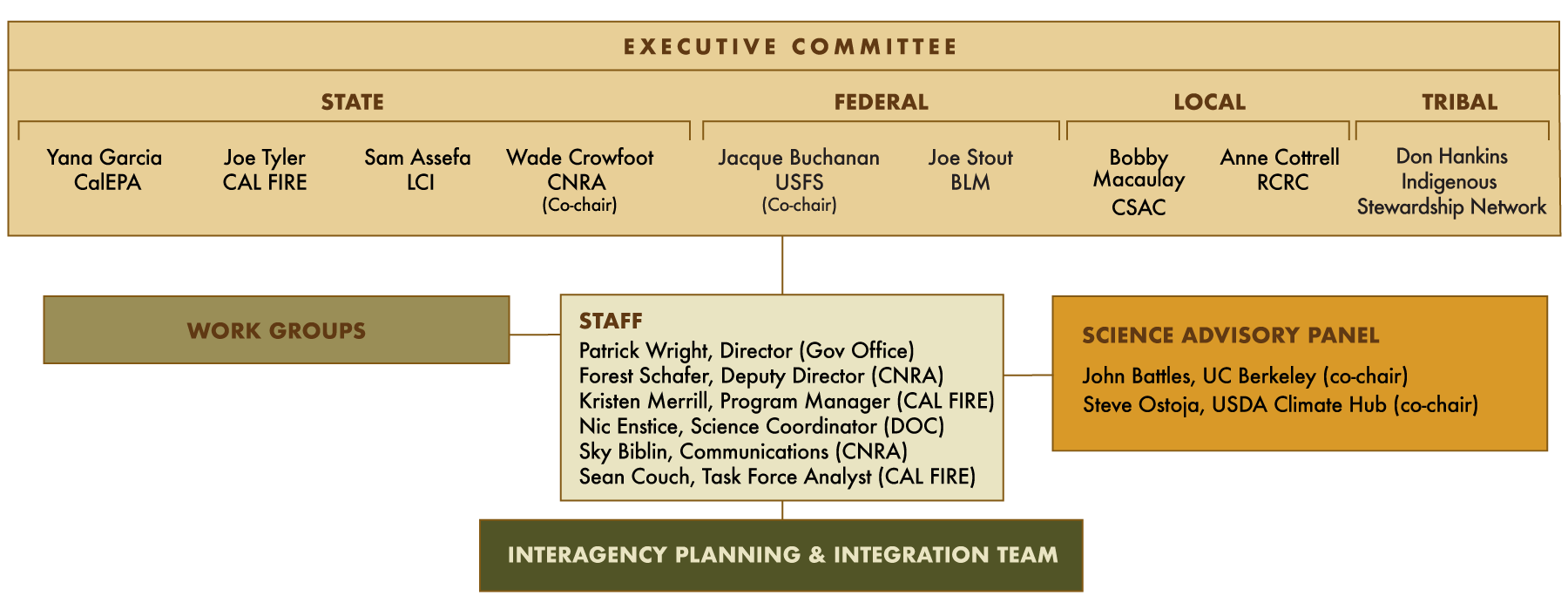
The Task Force operates through a collaborative governance structure that aligns state, federal, tribal, and local leadership. The Executive Committee – composed of senior leaders from the California Natural Resources Agency, CAL FIRE, the California Environmental Protection Agency, and the Governor’s Office of Planning and Research, along with federal, tribal, and local partners – provides strategic direction and policy guidance. The Planning and Integration Team coordinates participation across agencies, serving as a central hub for interagency communication and helping resolve issues as they arise. Additional agencies and stakeholders engage through the Task Force’s multiple Work Groups, which over the past five years have advanced the 99 key actions in the 2021 Action Plan, aligned agency activities, and developed the strategies and recommendations that form the foundation of this 2026 Action Plan.
The Task Force’s Science Advisory Panel supports science-based decision-making by translating relevant research for agency programs and identifying key knowledge gaps to inform future landscape and community resilience projects. Finally, Task Force staff play a critical coordination role by managing communications, tracking and reporting progress, supporting accountability, and organizing numerous state and regional convenings.
TASK FORCE WORK GROUPS & JOINT STRATEGIES
The Task Force convenes interagency and stakeholder-led Work Groups that bring together subject-matter experts on wildfire and landscape resilience issues. These Work Groups play a central role in coordinating partner agency efforts, informing policy development, and advancing implementation of shared priorities. They helped inform and review the 2026 Wildfire and Landscape Resilience Action Plan and continue to develop strategies and recommendations that build on and operationalize the 2026 Action Plan.
Published Strategies and Recommendation Documents
- California’s Forest Sector Workforce Study Report (November 2021): The Forest Sector Workforce Report assesses workforce needs across California’s forestry, fuels management, and wood products sectors, identifying critical positions, regional workforce gaps, and strategies to strengthen training and recruitment needed to support large-scale forest restoration and wildfire resilience.
- California’s Joint Strategy for Sustainable Outdoor Recreation and Wildfire Resilience (December 2022): The Sustainable Recreation Strategy outlines key actions to better integrate sustainable recreation planning with wildfire and landscape resilience efforts.
- California’s Strategic Plan for Expanding the Use of Beneficial Fire (March 2022): The Beneficial Fire Strategic Planprovides a coordinated roadmap for state, federal, and tribal partners to scale up prescribed fire, cultural fire, and managed fire to meet the state’s ecological, climate, public safety, public health, and cultural objectives.
- California’s Community Wildfire Resilience Roadmap (September 2025): The Community Wildfire Resilience Roadmap provides recommendations on a holistic approach to address critical risks and vulnerabilities in the built environment.
- Advancing Wildfire Resilience Workforce and Career Development in California (November 2025): Developed by the Sierra Business Council and The Watershed Research and Training Center, the Wildfire Resilience Workforce Reportprovides recommendations to build and sustain the workforce needed to scale up wildfire resilience efforts while creating quality jobs and supporting local economies.
Draft Strategies Accompanying the 2026 Action Plan
- California’s Wood Utilization Strategy: Builds on existing state and federal programs and investments and proposes new initiatives to address supply chain barriers, expand the state’s wood processing capacity, and develop low-carbon markets for forest-derived materials.
- California’s Private Forest Landowner Assistance Implementation Strategy: Outlines a coordinated framework to expand technical, financial, and educational support for small forest landowners to improve wildfire resilience and forest health.
Strategies and Recommendation Documents Under Development
- California’s Climate Informed Reforestation Strategy: Will establish statewide goals to accelerate post-fire reforestation, expand nursery and seed supply capacity, and promote climate-informed planting practices across land ownerships.
- California’s Resilient State Lands Strategy: Will guide coordinated restoration, wildfire resilience, and climate adaptation actions across 3 million acres of state-managed land