
Expand Wood
Utilization Capacity
To achieve the Action Plan’s goals, California must expand its wood and woody biomass processing capacity alongside growing treatment acreages. Without sufficient infrastructure, the state risks falling short of its treatment targets. In addition, developing markets for wood and forest byproducts can significantly reduce treatment costs. The 2025 American Forests Report estimates that viable markets could recover 33% to 50% of these expenses. California’s forest products sector can drive these efforts by providing the necessary workforce, equipment, and infrastructure to support rural jobs and the statewide manufacturing economy.
According to the 2025 American Forests Report, California must add processing capacity equivalent to 29 to 31 new average-sized mills statewide and 8 to 9 large-scale bioenergy facilities to process the material generated by treating one million acres annually. These findings underscore the importance of coordinated investments in wood product facilities to achieve the state’s forest health, wildfire resilience, and climate objectives.
In addition, the USDA Forest Service National Active Management Strategy calls for expanded timber production to reduce overly dense forests, make productive use of biomass, and support rural economic development. However, since timber harvest from federal lands makes up only about 16% of the state’s total, increasing federal timber sales by 25% (the goal of the Active Management Strategy) would be a modest step toward the ecological thinning goals of the Landscape Resilience Strategy.
While California has significantly increased investments in forest and wildfire resilience projects, wood utilization capacity has lagged. Absent viable outlets, an estimated 80% of biomass residues remain on the landscape with limited options other than pile burning or decaying in place. However, leaving fuels in place or piling residues without subsequent burning, as is the case with an estimated 250,000 piles across the Tahoe Basin alone, does not reduce near-term wildfire hazard [20], [21] . Conversely, when burned, piles can increase methane and localized PM 2.5 emissions [22]. Both cases can potentially undermine the effectiveness of state investments.
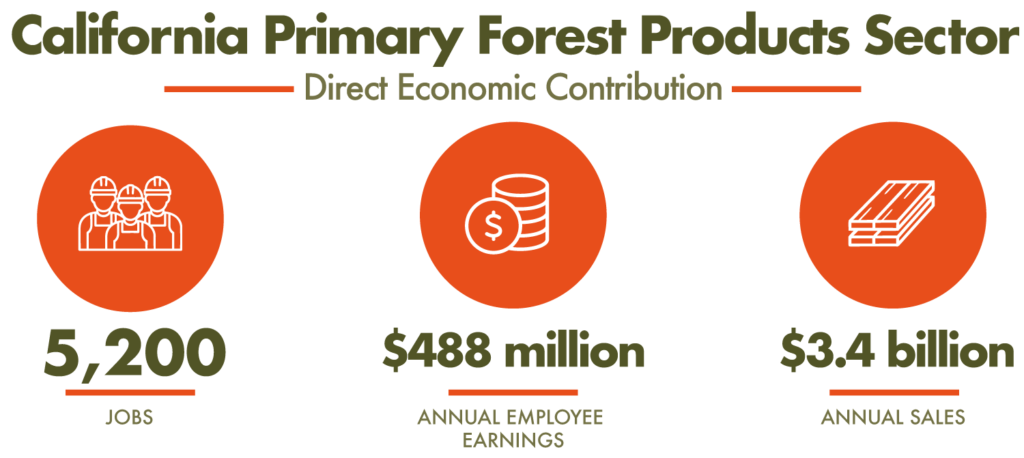
California’s wood products also provide significant economic benefits, particularly in rural areas [23], [24]. The forest products industry, including timber harvesting and wood processing, supports approximately 5,200 jobs, generates $488 million in annual employee earnings, and produces $3.4 billion in annual sales.
Over half a dozen state agencies share responsibility for wood utilization, including CAL FIRE, the Board of Forestry and Fire Protection (and its Joint Institute for Wood Products Innovation), DOC, the Governor’s Office of Land Use and Climate Innovation (LCI), California Air Resources Board (CARB), and the Governor’s Office of Business and Economic Development (GO-Biz). Each entity brings unique expertise, policy focus, and implementation tools to the issue. The Board of Forestry and Fire Protection, for example, is well positioned as a public convener and forum for discussion of forest practices, wood products and markets. Recent efforts by CNRA have brought these entities together to better coordinate and align the state’s wood utilization programs and policies.
Key Actions
Leadership/Governance
- 4.15 Organize a Nimble State Governance Structure: Building on recent efforts, CNRA will work with the Board of Forestry and Fire Protection, CAL FIRE, California Strategic Growth Council (SGC)’s energy investments team and others to identify options to coordinate, elevate and deliver state initiatives to advance wood utilization.
- 4.16 Develop a Comprehensive Wood Utilization Strategy: The Board of Forestry and Fire Protection and CAL FIRE, in coordination with SGC’s Factory Built Housing Program, will coordinate with key public and private partners to develop a comprehensive wood utilization strategy by the end of 2027.
Facility Development
- 4.17 Activate Climate Bond Funding to De-Risk Investment in Biomass Facilities: DOC will establish a loan program to catalyze private sector investments in non-combustion facilities and create a sustainable funding cycle supporting multiple rounds of economic development.
- 4.18 Implement the Forest Organic Residue Energy and Safety Transformation (FOREST) Program: Consistent with Assembly Bill (AB) 706 (Aguiar-Curry, 2026), the Board of Forestry and Fire Protection will establish and implement the FOREST program to support biomass power generation in strategically located regions while long-term markets for low-value wood are developed.
- 4.19 Expand Wood and Biomass Processing Capacity: Subject to available funds, CAL FIRE, DOC, and the USDA Forest Service will continue awarding grants to support facility development. LCI will evaluate the feasibility of creating a streamlined pathway for certain projects that utilize forest biomass on properties zoned as industrial and outside areas of extreme air quality nonattainment as part of the 2027 California Environmental Quality Act Guidelines update. GO-Biz will offer technical assistance to individual wood utilization businesses.
- 4.20 Support Small-Scale, Behind-The-Meter Facilities in Strategic Locations: CNRA, in consultation with the California Public Utilities Commission (CPUC) will explore options for supporting small-scale, behind-the-meter biomass facilities (up to 2 megawatts) that do not require ratepayers to fund above market costs, and are located in areas that advance wildfire safety and local jobs.
- 4.21 Explore Forest Biomass Gasification Pilots: CPUC will continue exploring biomass gasification, in accordance with CPUC Decision 22-02-025, which established the Renewable Gas Standard and ordered Southern California Gas Company and Pacific Gas and Electric Company to develop biomass gasification pilots.
Supply
- 4.22 Increase the Reliability of Wood and Biomass Supply: The USDA Forest Service and CNRA will partner to formalize commitments to expand their use of 20-year contracting mechanisms to increase supply certainty for projects seeking to utilize wood fiber from California’s national forests.
- 4.23 Establish Regional Woody Biomass Partnerships: Subject to the availability of funds, LCI will continue supporting the development of regional woody biomass partnerships to centralize the collection and contracting of biomass feedstock, and to serve as a broker for long-term contracts.
Mass Timber and Wood Products
- 4.24 Establish a California Mass Timber Strategy: With California’s newly created Mass Timber Coalition, the Board of Forestry and Fire Protection, in coordination with the USDA Forest Service, will coordinate with GO-Biz, other state and federal agencies, local and regional governments, educational and research institutions, and the private sector to develop a strategy to advance the use of mass timber and other engineered wood building products.
- 25 Support Wood Product Procurement for New State-Funded Buildings: The Board of Forestry and Fire Protection, in coordination with the California Department of General Services, will explore strategies to support increased use of California wood products, including mass timber, for use in state-funded projects involving building construction, with a priority on utilizing wood products that achieve goals for low-embodied carbon.
- 4.26 Incorporate California Wood Products in Housing Grant Programs: The California Housing and Homelessness Agency and SGC will explore and report on the use of mass timber and California wood products in developments funded by state housing programs.
- 4.27 Increase Communication and Promotion of Wood Products in California: The Board of Forestry and Fire Protection and the Joint Institute for Wood Products Innovation will amplify messaging regarding wood products and related issues in California. Increasing awareness will help support the industry development necessary to advance state forest restoration and climate goals.
Emerging Markets
- 4.28 Support Emerging Markets for Biochar: Subject to the availability of funds, CARB will assess the feasibility and science of biochar as a method of carbon sequestration, and the Joint Institute will develop a biochar market strategy, including a producer and consumer guidebook.
- 4.29 Maintain State Support for Forest Biomass to Bioenergy Grant Programs: Through funds made available through Proposition 4, DOC will continue to support projects utilizing forest biomass to make less carbon-intensive energy and other products.
Transportation
- 4.30 Improve Forest Product Transportation Efficiency: The California Department of Transportation, California Highway Patrol, and other appropriate state agencies will explore adjustments to truck weight requirements on non-federal transportation routes. Potential adjustments would increase biomass volume per trip, reduce fuel use and emissions per ton removed, and improve the economic feasibility of moving lower-value forest restoration byproducts to processing or bioenergy facilities.