
Expand Beneficial Fire
Many of California’s fire-adapted ecosystems now exist outside their historical fire regimes, creating conditions that fuel dangerous and destructive wildfires. “Beneficial fire,” which encompasses prescribed fire, managed wildfire, and cultural burning, provides a critical pathway for restoring fire to these landscapes. Expanding its use reduces the threat of extreme wildfire events, improves ecosystem health, supports tribal cultural stewardship, and restores the natural ecological processes that sustain biodiversity, water quality, and long-term landscape resilience.
To scale these efforts, the Task Force and its partners published California’s Strategic Plan for Expanding the Use of Beneficial Fire in 2022, establishing the nation’s first comprehensive roadmap and acreage targets across state, federal, tribal, and private lands. Executive Order N-35-25 subsequently advanced these goals by streamlining permits, accelerating funding, and prioritizing cultural burning.
More recently, the 2026 Good Fire Act, Assembly Bill AB 1699 (Rogers), removed critical barriers to implementation by:
- Establishing permanent liability protections for prescribed and cultural fire practitioners;
- Reducing regulatory hurdles for CAL FIRE to assist with local burning projects; and
- Expanding the qualified burn-boss workforce through certification reciprocity pathways.
Building on this foundation, the Landscape Resilience Strategy aims to establish beneficial fire as California’s primary tool for long-term landscape maintenance. However, decades of fire exclusion mean fire may be a challenge to safely return to all areas immediately. In some frequent-fire forests, mechanical thinning may first be needed to reduce heavy fuel loads and tree crowding.
To accelerate the widespread use of beneficial fire, the USDA Forest Service, CAL FIRE, and large private landowners are deploying Potential Operational Delineations (PODs). By dividing landscapes into distinct management units bounded by features like roads, ridgelines, and fuel breaks, PODs give communities a practical spatial framework to plan and execute beneficial fire at scale. By reducing fuel loads and pairing treatments with PODs and strategic fuel breaks, California can also create the conditions to increase managed fire as a cost-effective, efficient tool for reducing fuels, restoring fire-adapted ecosystems, and advancing landscape-scale management goals.
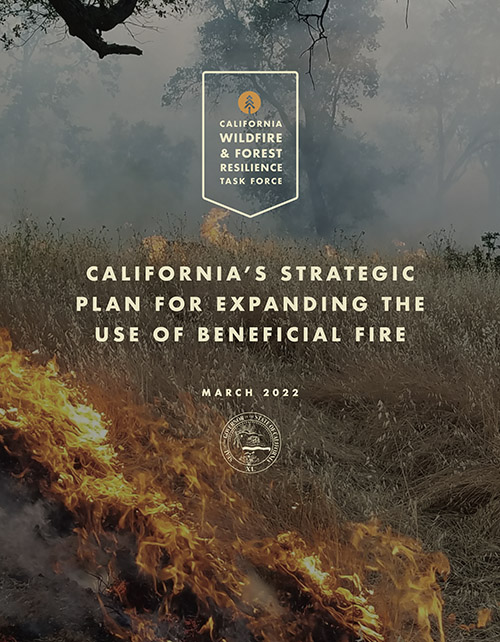
California’s Strategic Plan for
Expanding the Use of Beneficial Fire
The Task Force published California’s Strategic Plan for Expanding the Use of Beneficial Fire in 2022, the nation’s first comprehensive roadmap with acreage targets across all land ownerships.
Key Actions
- 1.06 Expand Beneficial Fire: State, federal, local, tribal, and private land managers – alongside non-governmental organizations, Resource Conservation Districts (RCDs), Fire Safe Councils, and Prescribed Burn Associations – will expand prescribed fire, managed wildfire, and cultural burning to support California’s beneficial fire targets in alignment with the Strategic Plan for Expanding the Use of Beneficial Fire.
- 1.07 Enhance Training and Workforce Capacity: CAL FIRE and the California Air Resources Board (CARB) will collaborate with partners to accelerate the launch of the Beneficial Fire Training Network, expanding training opportunities for practitioners, air districts, local health jurisdictions, and regulators. Additionally, CAL FIRE, the California Natural Resources Agency (CNRA), and CARB are partnering with the University of California Agriculture and Natural Resources (UC ANR) Fire Network to expand beneficial fire outreach, education, research, capacity building and training.
- 1.08 Expedite Implementation and Streamlined Permitting: Pursuant to AB 1699 (Rogers, 2026), CAL FIRE will provide direct assistance to local agencies and beneficial fire practitioners. Additionally, CAL FIRE will continue to streamline the state burn permit process and utilize template agreements to support burns led by landowners and other partner organizations. Consistent with SB 310 (Dodd, 2024), CNRA and local air districts will work collaboratively with federally recognized tribes to develop government-to-government agreements for cultural burning. CNRA and the California Environmental Protection Agency (CalEPA) will fast-track beneficial fire projects, pursuant to SB 1370. See Action 3.14 for more details on SB 1370 (Stern, 2026).
- 1.09 Expand Local Participation and Reduce Liability Barriers Pursuant to AB 1699 (Rogers, 2026), CAL FIRE will continue administering the Prescribed Fire Claims Fund and expand eligibility for coverage to include public entities outside of CAL FIRE and the federal government, including resource conservation districts, volunteer fire departments, colleges and universities, and others in addition to the existing non-public user base. Permanent and expanded coverage will reduce liability barriers and increase the pace and scale of prescribed fire and cultural burning across private and public lands.
- 1.10 Expand and Support Cultural Burning: CNRA, CalEPA, and their affiliated agencies will develop collaborative partnerships with California Native American tribes and prioritize tribal consultation across the work of the agencies to ensure tribal leadership and tribal priorities are incorporated into beneficial burning activities. Additionally, these agencies will strengthen partnerships with tribes through the creation of meaningful and durable land access and collaboration agreements to support cultural burning pursuant to the CNRA Tribal Stewardship Policy. CARB, in collaboration with air districts, will continue to collaborate with tribes to honor SB 310 (Dodd, 2024) air district agreements. Also see Key Actions 4.01 through 4.05 on supporting tribal stewardship.
- 1.11 Improve Smoke Management Consistency and Coordination: CARB, with CAL FIRE support, will standardize early and frequent collaboration practices between practitioners and air districts. Together, they will identify smoke management best practices that balance minimizing public smoke exposure with beneficial fire objectives. They will also develop guidance to support longer burn authorization windows where feasible while improving public communication regarding smoke impacts and mitigations.
- 1.12 Strengthen Modeling, Technology, and Reporting Tools: CARB will develop and make available new modeling and related technologies, including updating the Prescribed Fire Information Reporting System (PFIRS), to support air districts and practitioners and promote faster, more efficient permitting.
- 1.13 Provide Grant Support to Increase Beneficial Fire Capacity: Subject to the availability of funds, CAL FIRE will continue to support beneficial fire capacity-building initiatives through the Business & Workforce Development, Tribal Wildfire Resilience, and Forest Health Programs.
- 1.14 Use Recent Wildfires to Expand Beneficial Fire: Public and private land managers will seek to incorporate recent wildfire burn areas into management plans, using wildfire edges as control lines to introduce beneficial fire to adjacent areas.